Boxes, Barcodes, and a Bold Bet: Inside the American Supply-Chain Talent Pipeline Flowing Into Riyadh
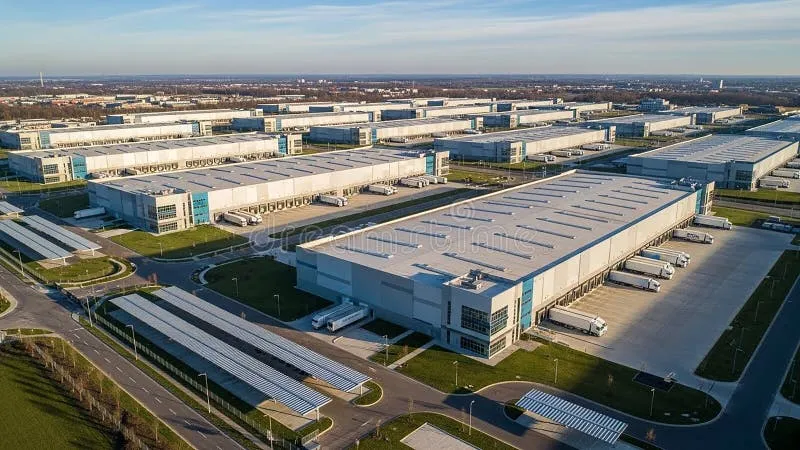
Photo: modern automated logistics warehouse distribution center aerial view, via thumbs.dreamstime.com
Ask most Americans what they know about Saudi Arabia's economy and the answers rarely go beyond oil. That picture is out of date. The Kingdom is spending tens of billions of dollars trying to position itself as the logistics bridge connecting three continents — Asia's manufacturing output, Europe's consumer markets, and Africa's fast-growing economies — and the single biggest bottleneck is not concrete or cranes. It is people who understand how modern fulfillment actually works.
That is where the Americans come in.
The Three-Continent Play
Geography has always been Saudi Arabia's quiet advantage. Roughly a third of the world's shipping passes within reach of its Red Sea ports, and the Kingdom sits squarely on the east-west corridor between Shanghai and Rotterdam. Vision 2030, the country's sweeping economic reform program, aims to convert that location into market share, with national targets calling for the logistics sector to climb into the global top tier of the World Bank's Logistics Performance Index.
The buildout is visible from the highway into Riyadh. Master-planned logistics zones near the capital and around Jeddah and Dammam are filling with automated sortation centers, bonded warehouses, and cold-chain facilities at a pace that American industrial developers would recognize from the e-commerce boom of the 2010s — compressed into a much shorter window.
What the Job Boards Actually Show
Scroll through postings from the major operators — the national carriers, the giga-project logistics arms, and regional e-commerce players — and a pattern emerges. Companies are advertising for warehouse operations directors, network optimization analysts, last-mile strategy leads, and customs technology managers, frequently with language noting that international experience is preferred.
Compensation is a genuine draw. A supply-chain director role in Riyadh commonly packages a tax-free base salary with housing allowances, schooling support, and annual flights home. A senior operations manager earning $110,000 in Columbus or Fort Worth may find the equivalent Saudi package, once benefits and the absence of federal income tax are counted, approaching double the take-home value. Recruiters in the sector describe the math as the strongest selling point they have.
Voices From the Floor
The Americans making the move tend to share a profile: they built their careers inside the massive US distribution ecosystems — the Memphis air-cargo corridors, the Inland Empire warehouses, the Atlanta and Dallas intermodal hubs — and they are drawn to the chance to build rather than optimize.
One former regional manager from a large American parcel carrier, now overseeing launch operations for a fulfillment campus outside Riyadh, describes the difference simply. In the States, he says, his job was squeezing percentage points out of a mature network. In Saudi Arabia, he is designing the network. Processes, vendor selection, training curricula — much of it is being written for the first time, by people like him.
A freight analyst who relocated from Chicago points to the technology leap as another magnet. New Saudi facilities are being equipped with automation and warehouse-management systems that many US operators have yet to deploy, meaning arrivals can work with tooling that would take a decade to justify back home.
The Adjustment, Honestly
This is not a frictionless move. Newcomers consistently flag three adjustments: the working week runs Sunday through Thursday, the pace of regulatory change can be disorienting even as it improves, and family logistics — schooling, licensing, banking — require patience in the first months. English is widely used in professional settings, but managers who learn even conversational Arabic report measurably smoother relationships with local teams and government liaisons.
The cultural exchange runs both ways. American managers bring an instinct for data-driven decision-making and a flat, direct communication style; Saudi operations bring scale, urgency, and a workforce that skews young and ambitious. The pairing, when it works, produces the kind of hybrid playbook that neither side could build alone.
Why It Matters for US Readers
For American supply-chain professionals, the boom represents something increasingly rare: a frontier market with first-world capital behind it. For US companies, it is a signal that their Gulf competitors and partners are institutionalizing quickly — and that the talent pool advising them now includes people trained in American logistics doctrine.
The desert, it turns out, is becoming a distribution map. And the people drawing it are increasingly carrying American résumés.