Six Weeks, Zero Keys: My Experiment Living in Riyadh on Foot, Metro, and an App Called Careem
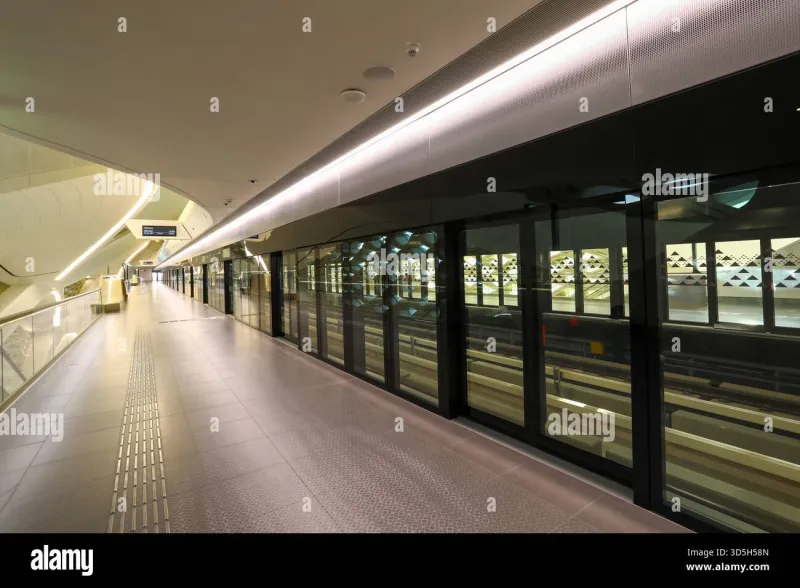
Photo: Riyadh Metro modern train station interior Saudi Arabia, via c8.alamy.com
When I told my Riyadh-based colleagues I was giving up my car for six weeks, the reaction was uniform: polite smiles, then a pause, then something like, "You know this is a driving city, right?" They weren't wrong. Riyadh grew up around the automobile the way Los Angeles did — wide arterials, district-scale blocks, and a cultural assumption that everyone arrives in their own vehicle. But with the Metro now running and ride-hailing cheaper than a Seattle parking garage, I wanted to know if the math had changed. So I handed back the keys and kept a log.
Week One: Learning the Metro the Hard Way
The Riyadh Metro is the part of the story most Americans haven't heard. Opened in late 2024 after a decade of construction, it's six color-coded lines, driverless trains, air-conditioned platforms, and fares that start around 4 Saudi riyals — roughly a dollar. My local commute on the Blue Line cost less than a single trip on the D.C. Metro.
The learning curve isn't the train itself; it's the stations. Several are embedded inside or beside malls and office towers, which sounds convenient until you're standing in a food court at 8 a.m. trying to find the escalator marked "Metro." Give yourself buffer time the first week. Stations are also spaced for a city of superblocks — expect a 10- to 15-minute walk from many apartment buildings, which brings us to the real constraint.
The Last Half-Mile Is Everything
Here's the honest assessment: the Metro works. The walk to it often doesn't. Riyadh's sidewalks range from excellent (newer districts near King Abdullah Financial District, or KAFD) to theoretical (older neighborhoods where the sidewalk is a dirt shoulder and the crosswalk is a suggestion). Summer heat turns a pleasant 12-minute stroll into a logistical problem between June and September.
This is why neighborhood selection matters more than transit maps. If you're going car-free, you want to live where the lines converge:
- KAFD and Al Olaya — the financial and commercial core, served by the Blue and Yellow lines, with genuinely walkable mixed-use blocks.
- Al Malqa and Al Wurud — residential but within reasonable reach of stations and delivery-heavy amenities.
- Near the Green Line corridor — runs through dense, older, more traditional commercial strips where daily errands are close by.
If your apartment is 25 minutes on foot from a station, you don't have a transit lifestyle. You have a ride-hailing lifestyle with occasional trains.
The Ride-Hailing Reality Check
Which is fine, actually, because ride-hailing in Riyadh is cheap. Between Careem and Uber, my average in-city trip ran 15 to 30 riyals ($4–8), with surge pricing during prayer-adjacent lulls and weekend evenings. Over six weeks, my combined transport spend — Metro passes plus roughly 40 rides — came to about $550. My previous month with a rental car, including fuel, insurance, and parking, exceeded $900.
Two cultural notes for American readers. First, drivers are chattier than what you're used to, and that's a feature — I got better neighborhood intelligence from Careem drivers than from any expat Facebook group. Second, pickup points can be ambiguous in older districts; learn to use the in-app map pin rather than the address field, or you'll spend ten minutes on the phone gesturing at landmarks.
What I Missed, and What I Didn't
The losses were smaller than I expected. Grocery runs required either a delivery app (Ninja and HungerStation are ubiquitous and fast) or a disciplined twice-weekly routine with a foldable cart. Social life shifted slightly — late-night gatherings in far-flung compounds meant a 40-riyal ride home, which I factored in like a New Yorker factoring in a cab from Brooklyn.
What I didn't miss: parking. Riyadh traffic is calmer than Houston's but parking is its own competitive sport, and abandoning it felt like a raise. I also didn't miss the highway interchanges, some of which appear designed by someone with a grudge against GPS.
Verdict: Possible, With an Asterisk
Can an American thrive in Riyadh without a car? Yes — if you choose your neighborhood before you sign a lease, treat the Metro as your backbone and ride-hailing as your flex muscle, and accept that July will test your commitment. The city is visibly being rebuilt around walkability, and in five years this article may read as quaint. For now, car-free life in Riyadh isn't the default. But it's no longer a stunt, either. I know, because I lived it.